Beiträge von kwakster


    Abercrombie & Fitch, New York, 1912
    In the center of the photo is a ski-lift chair and a display rack with ski apparati hanging from it.
    Also, there are skis and snow shoes to the right and left of the ski lift chair, repectively and men conducting transactions at the far left and center of photo.


    Abercrombie & Fitch, New York, 1913
    Sporting Goods, Interiors of Salesroom with Customers.


    Abercrombie & Fitch, New York, 1915, Madison Avenue and 45th Street.


    Abercrombie and Fitch store, New York, ca.1910, 44th Street and Madison Avenue

    The links below lead to several downloadable PDF's of old Abercrombie and Fitch catalogs on the website of Pennsylvania's Electronic library.


    A&F 1909 catalog: http://digitalcollections.powe…/pcalo-amc/id/11835/rec/4


    A&F 1913 catalog: http://digitalcollections.powe…n/pcalo-amc/id/7845/rec/4


    A&F 1915 catalog: http://digitalcollections.powe…n/pcalo-amc/id/8248/rec/1


    A&F 1916 catalog: https://archive.org/details/abercrombiefitch00aber


    A&F 1916 Christmas catalog: https://archive.org/details/abercrombiefitch00aber_0


    A&F 1950 catalog: http://digitalcollections.powe…n/pcalo-amc/id/8079/rec/5


    Background info about the company: https://www.acontinuouslean.co…bering-abercrombie-fitch/

    This is my second machine, a model 128 in a treadle, dating from 1925.
    We found it standing on the pavement in front of the home of an older lady, who was going to a smaller apartment and wanted to get rid of it.
    She still remembered her grandmother working with it back in the 1930's, but her mother and she had only kept it all these years for home decoration.
    For 15 Euro we could take it with us :)


    Sadly a few rainy days and nights outside had damaged the wooden table and case somewhat, but the machine itself was still unharmed as it had been covered by the wooden case.
    After i sanded the table i liked the wood grain so much (i think it may be red cedar) that i only treated it with several layers of a good quality mineral oil, and the drawers which normally hang under the table will get the same treatment.
    The machine has been cleaned and oiled, it has been fitted with a new rubber wheel for it's bobbin winder, and a new leather belt that connects the treadle with the machine is on it's way. (E-Bay)
    The treadle mechanism itself already ran smooth & silently on it's ball bearings, but i gave those a few drops of 5 weight Nano-Oil anyway.


    Currently learning to work a bit with an old Singer VS3 hand sewing machine made in 1890.
    When new a machine like this would cost you about a month's wages, but nowadays these can be bought for only a handful of euro's.
    I paid 10 Euro for mine, and there are literally dozens more where this one came from for similar prices.


    These high quality machines were made well before the era of planned obsolescence, and are basically indestructible.
    The inner workings on this one were covered in a shiny brown veneer that once used to be whale oil, but once that was removed and replaced by a few drops of 5 weight Nano-Oil here and there the machine works almost like new again.
    Also disassembled the wiggly wood parts to remove the remnants of the dried out bone glue, and then reglued everything with a good quality waterproof wood glue.
    Very useful if you want to take the machine with you to use in places without power sockets.


    The machine uses 15x1 size needles and easily stitches two parts of an old leather belt together (total leather thickness ~7,35 mm), so it just might work to make a simple leather knife sheath now and then (if i don't use overly thick leather)
    Also does very well for jeans, t-shirts, bed linen, etc.


    Also found this wonderful 1934 documentary about the manufacturing processes involved in making a Singer sewing machine at Clydebank, Glasgow, from its raw form of iron to the finished product packed and ready for export.
    Sadly without sound, but well worth it (if you like these kind of things)


    https://movingimage.nls.uk/film/1592


    ​

    Just used my last Buck 110 blade on an old & worn Buck 560 from a friend of mine.
    Had to use the old backspring as i'm all out of new ones, but luckily i still had a new blade, a pivot pin, and a bronze bushing.
    The new pivot pin wasn't riveted with a hammer, but pressed using a vise and a little home made tool.
    Pressing lessens the chances of damaging the handle plus it allows for a more precise tightening of the pivot, in this case to a 99.99 % bladeplay-free action.


    For people using diamond compounds on Paper Wheels like i do; give Nano-Oil 5 weight a try.
    I have been using this oil exclusively for quite a few years now, and so far it's the best i've come across.
    It remains speculation if that is because of the special "fullerene" additives or something else entirely, but it seems to make the diamond particles cut cleaner than anything else i've experimented with.
    Certain steels like ZDP-189 and S35VN come off the 15 micron diamond compound wheel completely burr-free and ready to use, which is something i've never been able to do with any other oil type.

    I think you did a great job already, especially considering how it looked before.
    Imo this knife would make a perfect candidate to thin the primary grind on wet & dry SiC paper and glass into a new edge that would consist of only a microbevel.
    This would lose the ugly old bevels with as little blade width loss as possible while at the same time making the blade cut a whole lot better.

    Flockton, Tompkin & Co 2-blade small knife with MOP scales.
    Made in Sheffield and complete with original leather pocket pouch.
    The knife was bought new around 1920 in Amsterdam, and it's still in very good condition.


    Specs:


    Length opened (with larger blade): 12,1 cm
    Length opened (with smaller blade): 10,8 cm
    Length closed: 7,5 cm
    Weight: 15 grams

    The knife has already proven to be a very effective short chopper during 2019 and 2020, with it's heavy convex blade in low alloy carbon steel combined with a stick tang covered in shock dampening rubber.
    Still working on thinning the convex blade shape a hair more every now and then, slowly approaching that sweet spot where the edge bites at maximum depth while at the same time the blade doesn't get stuck during chopping, and the saw on the back works best.
    I think i'm almost there.
    Pics were taken two weeks ago in the woods surrounding my home town.


    A little belated follow-up story:


    Upon closer inspection it turned out that this second Bowie had a number scratched in the brass guard, very small and only readable through a magnifying glass.
    That number was a social security number or SSN, which i managed to trace back to the man who put it there.
    The knife once belonged to James Michael Barnett, born: 08/23/1947, died: 11/12/2003, of 4301 Greenback Road; Utica, Kentucky.


    Then a friend of mine who still uses Facebook managed to find and even contact his widow, and asked her if she would like to have the knife sent back to her.
    While she declined that offer, she told my friend that she remembered the big Bowie as the knife Michael carried and used while stationed in Vietnam, and also after he returned to the US.
    Michael enjoyed woodworking and the outdoors, through gardening and working in his yard.
    His knife now has a prominent place in a display cabinet in the Netherlands.


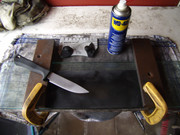
    Just finished hand regrinding this older ScrapYard Wardog in INFI steel using wet & dry SiC paper, first on on glass then on rubber with WD40 oil as a lubricant.
    The old convex edge measured ~40 degrees inclusive at the heel widening to ~50 degrees inclusive at the belly, while the new convex edge measures an even ~30 degrees inclusive from heel to tip.


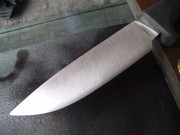
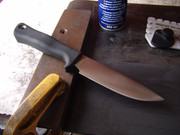
    Blade crosshatched with a red marker, which i find useful to see where exactly i'm removing steel in the beginning.
    The apex has been removed by pulling the old edge a few times very lightly over a fine diamond plate.
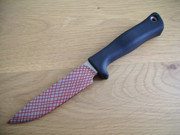
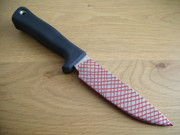
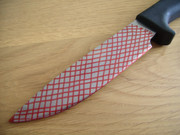
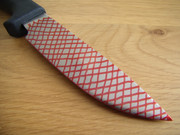
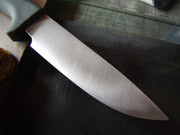
    The almost 6 mm thick INFI blade:
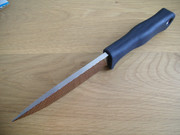


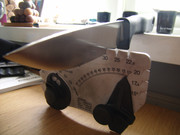
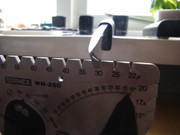
    After hand regrinding the blade on 1/2 a sheet of 180 grit SiC to a shallower convex edge (without producing a burr), while regularly checking with the Tormek AngleMaster to make sure that the new apex would fit in the 30 degrees inclusive slot.
    Time spent up to this point: 2 hours


    After the first refining steep on 1/3 of a sheet of 240 grit SiC, this time creating a small and even burr (only when the grit became increasingly finer due to SiC's friable nature)
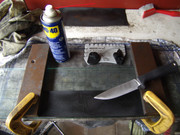
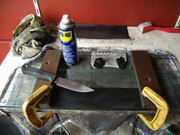
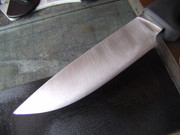
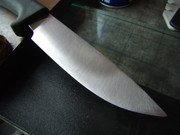
    Busy refining the scratch pattern and the burr on 1/2 a sheet of 400 grit SiC, but now on a semi-hard rubber backing, again using WD40 as a lubricant.
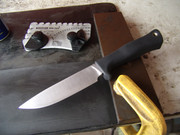

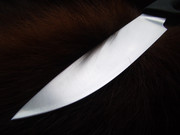
    The burr has been removed on the Tormek leather wheel with 1.0 micron diamond compound to reveal a toothy edge that is reverse chesthair whittling sharp.
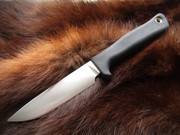
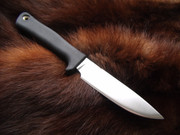
    Specs:


    Overall length: 24,5 cm
    Blade length: 12,2 cm
    Max blade thickness (ricasso): 5,98 mm
    Steel: INFI
    Hardness: 58-60 HRC
    Handle material: Resiprene-C rubber
    Weight: 176 grams

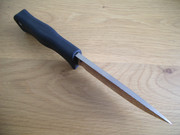
    The finished knife.
    Both blades can now shave armhair above the skin, the joints have had a few drops of 5-weight Nano-Oil, and the knife is fully usable again.


    Specs:


    Maximum length opened: 17.0 cm
    Maximum length closed: 10.0 cm
    Blade length main blade: 7.1 cm
    Maximum thickness main blade (ricasso): 3.2 mm
    Blade length secondary blade: 4.6 cm
    Maximum thickness secondary blade (ricasso): 1.96 mm
    Steel: Crucible steel
    Handle materials: Cocobolo wood, solid nickel silver bolsters & shield inlay on brass liners.
    Pocket pouch: blue leather

    How the main blade currently looks.
    It's surfaces have for now been finished on 1000 grit wet & dry on a semi-hard rubber backing using WD40 oil as a lubricant.
    A microbevel has been applied on the white sticks of a Spyderco Sharpmaker at the ~30 degrees inclusive setting, again using some WD40.


    And the smaller blade:


    As i intend to carry & use this well made old knife for a while i'm treating it to some TLC.
    Already cleaned everything thoroughly using toothpicks, a old toothbrush, an ultrasonic cleaner, and also electrolytically.
    Then removed the bladeplay in the pivot and gave the old wood panels a few coats of IKEA mineral oil and a topcoat of Granger's wax.


    Currently in the process of reshaping & regrinding both blades, the points of which now don't stick out of the handle in the closed position anymore.
    This is the smaller blade after hand regrinding it ever so slightly convex on 400 grit wet & dry SiC paper clamped on a piece of hardened glass using WD40 as a lubricant.
    There's a visible burr all along the edge, so it's now ready for one or more refining steps.
    The single sided swedge was redone with a small diamond file.


    And the larger blade.
    It's double sided swedge was also redone with the small diamond file.